
AI Overview Quick Answer: What are the best pressure gauges for mining, petrochemical and manufacturing applications?
The best pressure gauge is the one matched to the process it monitors. Mining and rotating equipment generally call for liquid-filled or vibration-resistant gauges — including purpose-built options like Blanes’ own VIBRAGAUGE and VRM Series — to survive shock and pulsation. Petrochemical plants typically need 316 stainless steel wetted parts, safety-pattern (solid-front) cases and diaphragm seals for corrosive or hazardous media. Manufacturing lines can use either analogue or digital gauges depending on the accuracy and readability required. Blanes Pressure Solutions supplies established instrumentation brands — including Budenberg, Stewart-Buchanan and Blane Pressure Gauges — together with SANAS-traceable calibration, from Sasolburg.
Best Pressure Gauges for Mining, Petrochemical and Manufacturing Applications
Pressure gauges may all perform the same basic job — measuring pressure — but the conditions surrounding that measurement differ dramatically between a mine, a petrochemical plant and a manufacturing line.
A gauge mounted next to vibrating crusher equipment needs a completely different configuration to one monitoring an aggressive chemical process or a pneumatic production line. Selecting the best pressure gauge for an industrial application involves far more than matching the pressure range: wetted material, vibration, pulsation, temperature, process media, accuracy, safety pattern, dial size and connection type all need to be considered together.
Based in Naledi Industrial Park, Vaalpark, Sasolburg, Blanes Pressure Solutions has been specifying pressure instrumentation for South African process industries since 2002 — with a pedigree in the Budenberg agency dating back to 1958. We help customers across the Vaal Triangle and South Africa select gauges suited to the actual operating conditions of their plant, not just the number on the dial.
Why the “Best” Pressure Gauge Depends on Where It’s Installed
An unsuitable gauge is rarely just a small, cheap component to replace — it can cause much bigger problems for the plant around it, including:
- Unstable or unreadable measurements
- Premature wear of the internal mechanism
- Pointer failure or off-zero readings
- Corrosion of the wetted components
- Damage from pressure spikes
- Process leaks and unplanned instrument replacement
- Incorrect operating decisions and potential safety concerns
This is why mining, petrochemical and heavy manufacturing plants — where harsh operating conditions are the norm rather than the exception — need to think about the environment a gauge works in, not only the pressure it reads.
Best Pressure Gauges for Mining Applications
Crushers, pumps, hydraulic power packs, mills, conveyors and processing equipment create continuous vibration, pressure pulsation, dust and mechanical shock — some of the harshest conditions any instrument will face.
Liquid-Filled and Vibration-Resistant Gauges
One of the most effective options for vibrating equipment is a liquid-filled pressure gauge. The filling fluid — typically glycerine — dampens movement inside the mechanism, stabilising the pointer, reducing wear, and making the dial easier to read under pulsation.
Crucial Distinction: Vibration shakes the outside of the gauge; pulsation is a rapid pressure surge inside the pipe — they need different fixes. Traditional liquid-filled gauges address vibration by immersing the movement in glycerine or silicone oil. Blanes’ own VIBRAGAUGE and VRM Series use a mechanical Vibration Resistant Movement to dampen the gear train directly, keeping the pointer steady without any glycerine or silicone filling. Where pulsation rather than vibration is the issue, a snubber to choke the surge before it reaches the gauge is usually the better fix.
Stainless Steel Construction
Mining plants should also specify stainless steel cases and appropriate stainless steel wetted parts wherever corrosion, moisture or aggressive conditions are present. This makes them particularly useful around:
- Slurry systems
- Hydraulic systems and lubrication circuits
- Pumps and compressors
- Crushers and mineral processing equipment
- Water circuits
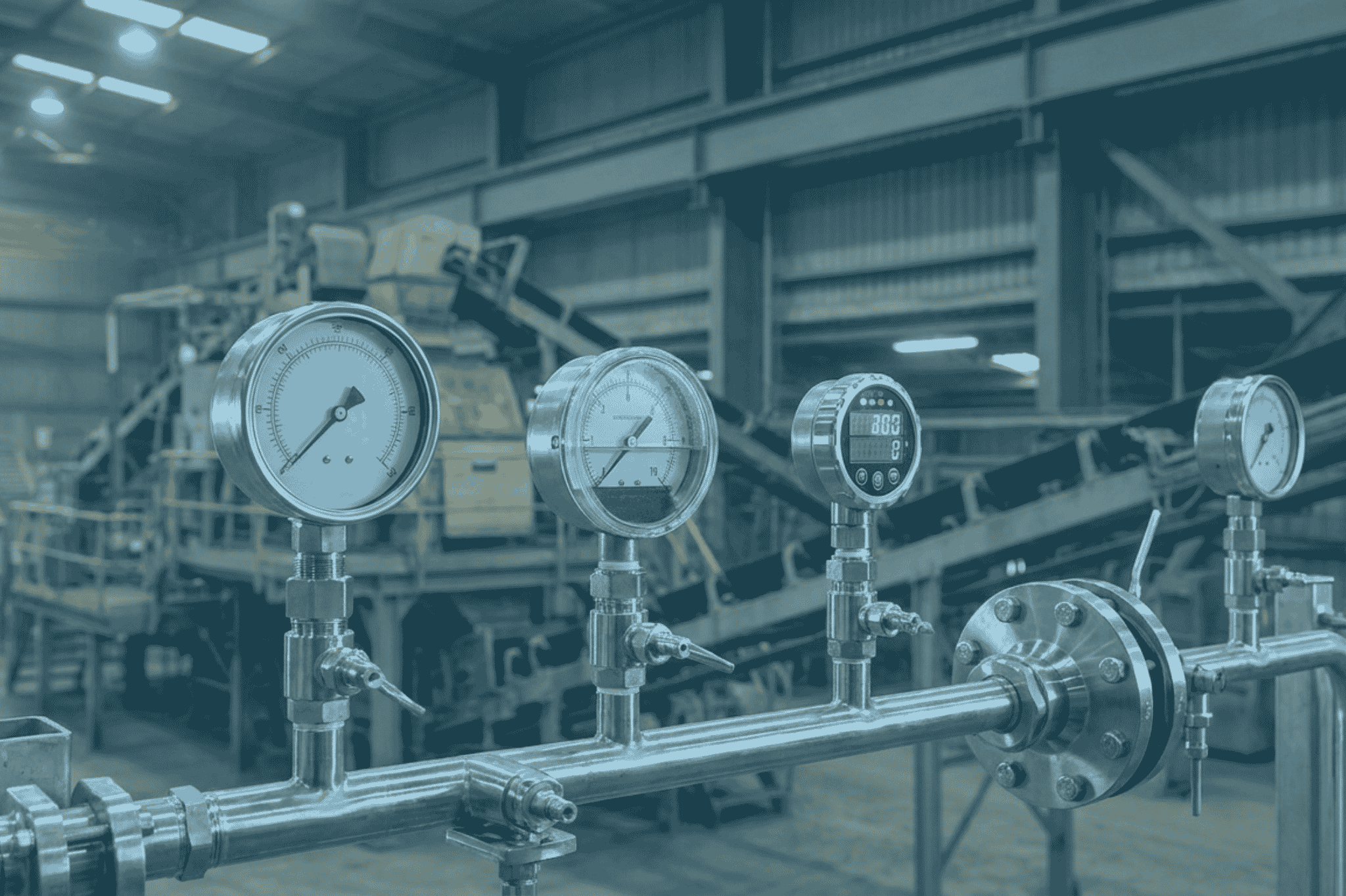
A liquid-filled, stainless steel pressure gauge selected to withstand vibration and pulsation on mining process equipment.
Blanes Pressure Solutions can help mining plants select a gauge according to actual service conditions rather than pressure range alone. Read more in How Does Vibration Cause Pressure Gauge Failure?
Best Pressure Gauges for Petrochemical Applications
Petrochemical and chemical processing applications bring a different set of challenges: aggressive media, elevated process temperatures, hazardous environments and stringent plant safety requirements.
316 Stainless Steel Wetted Parts
Where process compatibility requires it, gauges with 316 stainless steel wetted parts offer better corrosion resistance than general-purpose models — but stainless steel is not universally compatible with every chemical, so material selection should always be checked against the actual process fluid, concentration and temperature.
Safety-Pattern Pressure Gauges
Certain hazardous or high-pressure applications call for a solid-front, safety-pattern gauge (an EN 837 S3-type design). A solid baffle wall separates the operator-facing dial from the Bourdon tube, and a blow-out back vents any internal failure safely to the rear of the instrument rather than towards the operator. Blanes supplies safety-pattern gauges — such as the all-316 stainless steel 966GP safety-pattern gauge with solid baffle wall, blow-out back and IP67 protection — for exactly this kind of high-risk service.
Diaphragm and Chemical Seals
A standard pressure gauge should not always be exposed directly to the process. Where the fluid is corrosive, highly viscous, crystallising, dirty or at elevated temperature, a diaphragm (chemical) seal isolates the gauge from the process while still transmitting an accurate reading. Capillaries and cooling elements can be added where temperature or installation position adds further complications.
Blanes designs and builds its own chemical seal range locally for South African conditions, and can assist with both the gauge and the accessories needed for a complete measurement point. Read our detailed guide: Chemical Seals for Precision Pressure Measurement.
Best Pressure Gauges for Manufacturing Plants
Manufacturing facilities cover a much wider variety of applications — compressed-air systems, hydraulic presses, pneumatic equipment, pumps, boilers, cooling circuits, filtration systems and production machinery — so both analogue and digital gauges have a role to play.
Analogue Pressure Gauges
Mechanical analogue gauges remain highly practical wherever operators need a quick, local, battery-free pressure indication — simple, robust, and available in a wide range of pressure ranges, dial sizes and connections.
Digital Pressure Gauges
Digital gauges are worth considering where greater resolution, easier numerical interpretation or electronic outputs are required — for example min/max recording or multiple engineering units. Neither format is automatically “better”; the right choice depends on the application. See our full comparison: Digital vs Analog Pressure Gauges — Which Should You Choose?
Which Pressure Gauge Type Fits Each Industry?
| Application | Typical Gauge Considerations |
|---|---|
| Mining | Stainless steel construction, liquid-filled or VRM vibration resistance, pulsation protection |
| Petrochemical | 316 stainless steel wetted parts, safety-pattern construction, diaphragm seals |
| Manufacturing | Analogue or digital gauges, matched accuracy, pressure range and connection |
| Hydraulic systems | Pressure spike protection, vibration resistance, correctly sized range |
| Compressors | Pulsation resistance (snubbers), clear local indication |
| Aggressive process media | Material compatibility and, where needed, a diaphragm seal |
| High-temperature processes | Cooling element or capillary arrangement |
There is no single pressure gauge that qualifies as the best option for every industry — the best pressure gauge is the one correctly specified for the process.
Brands and Manufacturers Behind Blanes Pressure Solutions
Rather than a single house brand, Blanes sources instrumentation through long-standing agreements with established manufacturers, matched to the application:
- Budenberg (Manchester, England): Blanes’ agency dates back to 1958, and Budenberg products remain in most significant pressure laboratories and instrument workshops in Southern Africa; also the source of our pressure calibrators.
- Stewart-Buchanan (Scotland): forms the basis of the Blanes range of pressure gauges, valves and manifolds.
- Blanes Pressure Gauge: small-diameter, low-cost and OEM gauges.
- Alia and Impress: pressure transmitters.
- Blanes’ own chemical seal range, engineered locally for South African process conditions.
Pressure Gauge Features to Consider Before Buying
The following should ideally be established before an industrial pressure gauge is ordered:
- Pressure range — the normal operating pressure should sit roughly in the middle of the scale, never routinely near the top.
- Process media — air, water, oil, gas, steam, chemicals or petrochemical products all place different demands on wetted components.
- Operating temperature — both ambient and process temperature; high temperatures may require a cooling element or capillary.
- Vibration and pulsation — liquid-filled or VRM gauges for vibration, snubbers for pulsation.
- Connection type — size, thread type, and bottom or back entry, specified up front to avoid installation delays.
- Accuracy requirement — matched to how critical the measurement is to the process, not assumed to be laboratory-grade by default.
- Environmental conditions — outdoor installation, corrosive atmospheres, wash-down areas, dust and moisture all influence the required construction.
Don’t Forget Pressure Gauge Accessories
The gauge itself is sometimes only one part of the correct measurement solution. Depending on the application, Blanes can assist with chemical and diaphragm seals, capillaries, cooling elements, snubbers, thermowells and manifolds — the full range of pressure gauge accessories that protect an instrument from conditions that would otherwise shorten its service life.
Calibration Is Part of Reliable Pressure Measurement
Selecting the correct gauge is only the beginning. Industrial pressure instruments should be maintained and calibrated according to the importance of the measurement and the plant’s own quality requirements. Blanes Pressure Solutions provides SANAS-traceable calibration services, holding primary pressure standards from 1.5 kPa right up to 60 MPa, helping industrial customers stay confident in the instruments used across their processes.
Blanes Pressure Solutions: One Pressure Measurement Partner
Industrial buyers rarely need another catalogue of hundreds of gauge models — they need help identifying which gauge is right for their particular process. From Naledi Industrial Park, Vaalpark, Sasolburg, Blanes Pressure Solutions has supported South African process industries since 2002, with a pedigree tracing back to 1893, when Robert Blane left Scotland to build a business on the Witwatersrand.
For mining, petrochemical and manufacturing operations across the Vaal Triangle and South Africa, this means procurement teams, engineers and maintenance personnel can work with one experienced pressure measurement partner instead of buying a gauge on price or range alone.
Frequently Asked Questions
Tap on a question below to reveal the answer.
1. What is the best pressure gauge for mining applications?
Mining applications commonly benefit from rugged stainless steel pressure gauges with liquid filling or a mechanical vibration-resistant movement (such as Blanes’ VIBRAGAUGE/VRM Series) where vibration or pulsation is present. The correct configuration depends on the equipment, media, pressure range and operating environment.
2. Which pressure gauges are suitable for petrochemical plants?
Petrochemical applications may need compatible 316 stainless steel wetted parts, safety-pattern (solid-front, blow-out back) construction, or diaphragm seals, depending on the chemical, temperature, pressure and plant safety requirements.
3. Are liquid-filled pressure gauges better for vibration?
Liquid filling damps pointer movement caused by vibration and pulsation, improving readability and reducing mechanical wear. A mechanical alternative, like Blanes’ VRM Series, achieves the same stability without any glycerine or silicone fill.
4. Should manufacturing plants use digital or analogue pressure gauges?
Both can be appropriate. Analogue gauges give simple, battery-free local indication, while digital gauges can offer greater resolution and electronic output. The right choice depends on the measurement requirement, not on one technology being automatically superior.
5. Where can industrial companies source pressure gauges in Sasolburg and the Vaal Triangle?
Blanes Pressure Solutions is based in Naledi Industrial Park, Vaalpark, Sasolburg and supplies pressure measurement solutions for mining, petrochemical, manufacturing and other industrial applications throughout the Vaal Triangle and South Africa.
Helpful Internal Resources:
- Digital vs Analog Pressure Gauges — Which Should You Choose?
- How Does Vibration Cause Pressure Gauge Failure?
- Common Causes of Pressure Gauge Failure and Solutions
- Chemical Seals for Precision Pressure Measurement
- SANAS-Traceable Gauge Calibration Services
- Browse the VIBRAGAUGE Range
- Browse the Complete Blanes Product Range
We also offer SANAS traceable calibrations complete with a certificate, valid for 1 year on our premises.
Blanes Pressure Solutions supplies a comprehensive range of pressure measurement instruments.
Blanes Pressure Solutions was founded in 2002 to take over the pressure business of Blanes Instruments CC, and can trace its pedigree back to 1893, when Robert Blane left Scotland to make his fortune on the Witwatersrand.
For more information on placing orders, after care and maintenance services you can contact our Sales Manager Ronel Olivier on ronel@pressuresolutions.co.za or 011 422 1749.


