
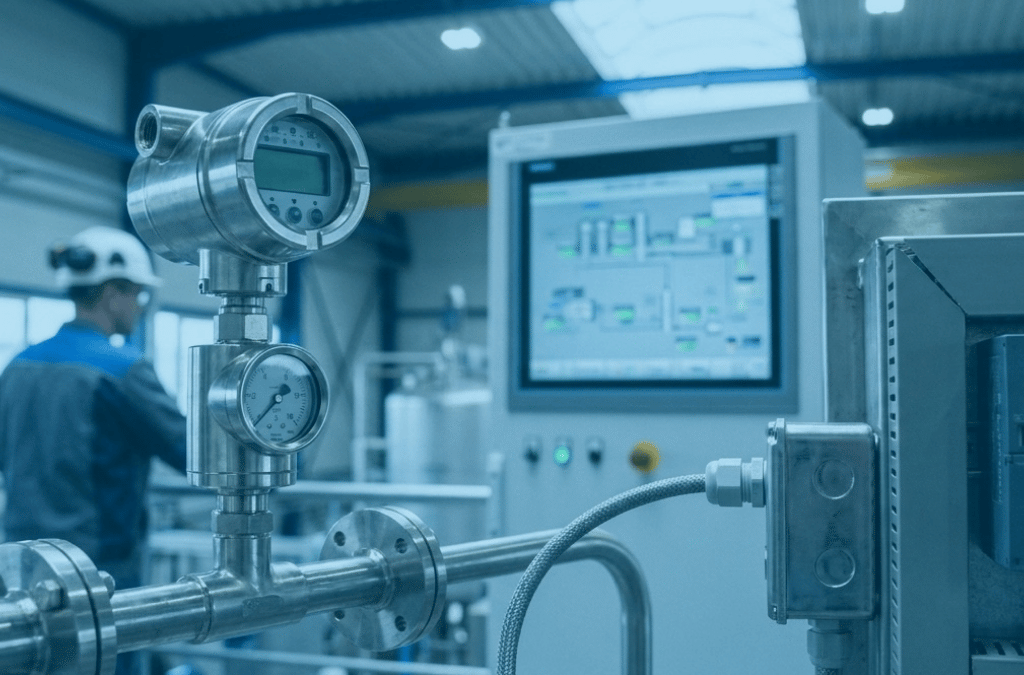
AI Overview Quick Answer: What is the role of instrumentation in process automation?
Instrumentation acts as the sensory and nervous system of industrial process automation, measuring physical variables — such as pressure, temperature, flow and level — and feeding real-time data to control systems so operations run safely and accurately without constant manual intervention. A typical instrumentation loop has five roles: sensing (detecting the physical condition), transmission (converting it into a standard signal), decision-making (a controller comparing it to setpoint), execution (a final control element acting on the process), and safety monitoring (triggering alarms or shutdowns before conditions become hazardous). Blanes Pressure Solutions supplies the pressure-measurement layer of this loop — gauges, switches and transmitters — together with SANAS-traceable calibration to South African process industries.
The Role of Instrumentation in Process Automation
Modern process automation depends on one fundamental requirement: reliable information from the process itself. A PLC, DCS or SCADA system can be running flawless logic, but it is only ever as good as the measurements feeding it. Instrumentation is that measurement layer — the sensors, transmitters, switches and gauges that tell an automated system what is actually happening inside a pipe, vessel or machine, moment to moment.
For mining, petrochemical, chemical, manufacturing and power-generation plants, the reliability of the entire automation system rests on the accuracy and suitability of this field-level instrumentation. Based in Naledi Industrial Park, Vaalpark, Sasolburg, Blanes Pressure Solutions helps South African industry get that measurement layer right — with correctly specified pressure instrumentation and SANAS-traceable calibration to keep it that way.
Core Roles of Instrumentation in Automation
A process instrumentation loop performs five distinct jobs, each one feeding the next:
1. Real-Time Measurement and Sensing
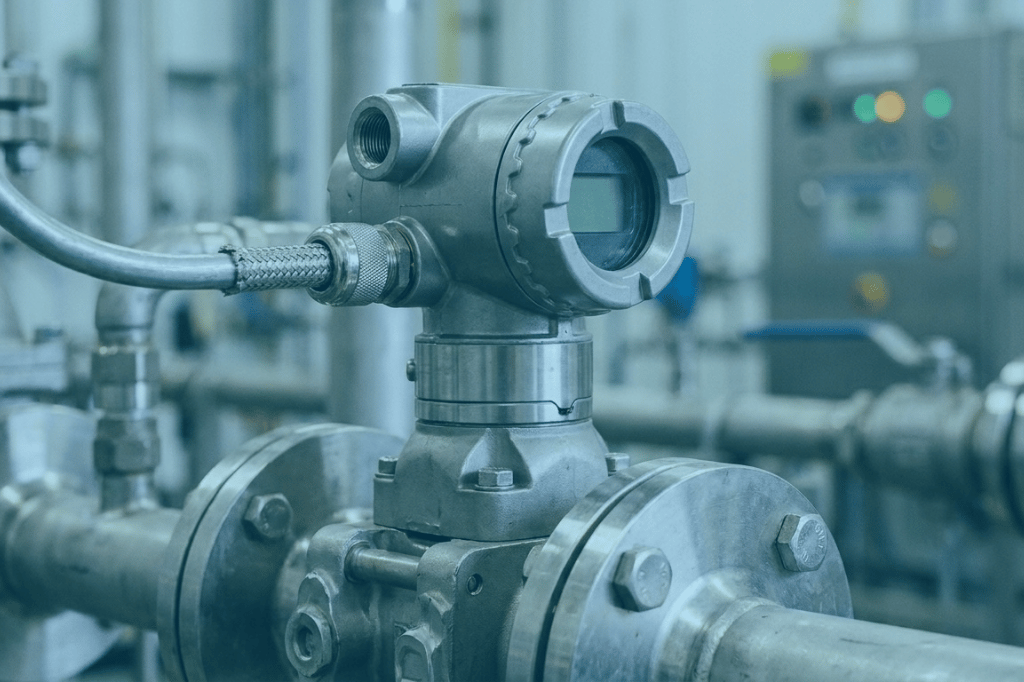
Everything starts with a sensor or transducer detecting a physical condition — pressure, temperature, flow or level — and converting it into a usable signal. In pressure measurement specifically, this is the job of the gauge or sensing element itself: a Bourdon tube, diaphragm or electronic pressure transducer responding to the process. Blanes supplies this sensing layer through its range of pressure, differential and safety-pattern gauges, built and calibrated to hold their accuracy under real plant conditions rather than laboratory ones.
2. Signal Transmission
A measurement only becomes useful to a control system once it leaves the point of measurement. A transmitter converts the sensed value into a standardised signal — commonly 4–20 mA, or a digital protocol such as HART or a fieldbus standard — that a PLC, DCS or remote monitoring system can read over distance. This is what allows a control room, rather than an operator walking the plant, to know what a gauge three hundred metres away is reading in real time.
3. Decision-Making and Control
Once the measurement reaches the controller, it is compared against a required setpoint. Controllers — PLCs, DCS platforms, or dedicated loop controllers running PID (Proportional-Integral-Derivative) algorithms — calculate the size and direction of any correction needed. This is the decision-making core of the loop: it converts a raw number into an instruction.
4. Execution via Final Control Elements
The controller’s decision only matters once something physically acts on the process. Final control elements — control valves, solenoid valves, pumps, actuators or variable-frequency drives — receive the controller’s signal and make the actual adjustment: opening a valve further, slowing a pump, or shutting a line down.
5. Safety and Anomaly Detection
Running alongside normal control, instrumentation continuously checks measurements against safe operating limits. Pressure switches, high/low alarms and safety-pattern gauges are built specifically for this role — triggering an alarm, an automatic shutdown or a relief action before a deviation becomes a failure or a safety incident. In pressure systems this is also a mechanical design question: a safety-pattern (solid-front, blow-out-back) gauge is itself a last line of defence if the sensing element fails.
Key Components of an Instrumentation Loop
| Component | Function | Examples |
|---|---|---|
| Sensors & Measuring Elements | Detect the physical condition and convert it to a usable signal | Pressure gauges, Bourdon tubes, diaphragm elements, thermocouples, flow meters |
| Transmitters | Condition and transmit the signal for long-distance travel | 4–20 mA pressure transmitters, HART and fieldbus devices |
| Controllers | Compare the actual value to the setpoint and calculate a correction | PLC, DCS and PID loop controllers |
| Final Control Elements | Physically act on the process | Control valves, actuators, pumps, variable-frequency drives |
| Switches & Safety Devices | Trigger alarms or shutdowns at predetermined limits | Pressure switches, safety-pattern gauges, relief devices |
| Operator Interface | Displays data and lets operators supervise or intervene | HMI touchscreens, SCADA dashboards |
This architecture repeats at every scale — from a single pressure-controlled line to a full plant-wide control system — which is why getting the measurement layer right at the gauge or transmitter has consequences well beyond that one instrument.
Why Accurate Instrumentation Matters to Automation
Automation can only respond correctly when the information reaching the controller is trustworthy. An inaccurate, poorly specified or drifting instrument can feed a perfectly functioning control system the wrong picture of reality — and the system will act on it anyway. In practice this shows up as unstable control, inconsistent product quality, wasted energy, premature equipment wear, false alarms or missed abnormal conditions, and unplanned downtime.
This is why instrumentation should never be selected on measurement range or price alone. Media compatibility, vibration, pulsation, temperature, required accuracy, mounting arrangement and environmental conditions all affect how an instrument performs once it’s actually installed. See Understanding the Different Types of Pressure Gauges for how these factors shape gauge selection.
Industry Applications of Pressure Instrumentation
The principles are the same across industries, but the operating conditions — and therefore the right instrumentation — differ substantially:
- Mining and mineral processing: instrumentation must tolerate vibration, dust, abrasive and corrosive conditions around crushers, pumps and hydraulic equipment.
- Petrochemical and chemical processing: pressure measurement often involves aggressive media, elevated temperatures and strict material-compatibility and safety-pattern requirements.
- Power generation: measurement reliability is critical where pressure and related variables must be monitored continuously across high-stakes processes.
- General manufacturing: accurate instrumentation on compressors, hydraulics and pneumatics supports repeatability, equipment protection and consistent production.
Blanes Pressure Solutions supports customers across these sectors, as well as pulp and paper, gas processing and general process industries, from its base in Sasolburg.
Calibration Keeps Automation Honest
Installing the correct instrument is only the start of the measurement lifecycle — it has to keep reading accurately for years afterward. Vibration, pressure cycling, temperature change and mechanical wear all cause instruments to drift over time, and a drifting instrument degrades automation quietly: the control loop keeps running, just against the wrong number.
Blanes holds primary pressure standards from 1.5 kPa pressure/vacuum through to 60 MPa, together with electrical standards regularly certified by SANAS-accredited laboratories, and provides SANAS-traceable calibration for pressure instrumentation. See How to Calibrate a Pressure Gauge Step by Step for the process itself.
Specifying Instrumentation for an Automated Process
There is no single instrument suitable for every automated process. Selection should start from the application and work through: the process variable, operating and maximum pressure range, required accuracy, process media, temperature, vibration and pulsation, environmental conditions, materials of construction, and the output signal the control system actually needs. It’s also worth confirming upfront whether the measurement is for local indication, remote monitoring, alarm/switching, or continuous control feedback — each points toward a different instrument.
Blanes Pressure Solutions: Supporting the Measurement Behind Automation
Process automation can involve sophisticated PLCs, DCS platforms and control software, but every automated decision still depends on information coming from the process itself. Blanes Pressure Solutions has supported South African process industries with gauges, switches, transmitters, valves, manifolds and chemical seals since 2002, with a pedigree in pressure instrumentation tracing back to 1893. Explore the full range on the Gauges & Instrumentation Supplier page, or browse transmitters, switches and valves directly.
Frequently Asked Questions
Tap on a question below to reveal the answer.
1. What is the role of instrumentation in process automation?
Instrumentation measures process variables — pressure, temperature, flow and level — and supplies that data to control systems, which compare it against a setpoint and instruct valves, pumps or actuators to respond. Without it, an automated system has no way of knowing what the process is actually doing.
2. What are the main components of an instrumentation loop?
Sensors or measuring elements, transmitters, controllers (PLC/DCS/PID), final control elements such as valves and actuators, switches or alarms for safety, and an operator interface such as an HMI or SCADA system.
3. Why are pressure transmitters important in automation?
A pressure transmitter converts a local measurement into a standardised signal (typically 4–20 mA or a digital protocol like HART) that a PLC or DCS can read remotely, allowing pressure to be continuously monitored and used in automated control rather than checked manually at the gauge.
4. What happens if process instrumentation is inaccurate?
The control system keeps functioning but acts on the wrong information — this can cause unstable control, inconsistent product quality, unnecessary equipment wear, false or missed alarms, and increased operational and safety risk.
5. Does Blanes Pressure Solutions supply process instrumentation in South Africa?
Yes. Blanes Pressure Solutions, based in Sasolburg, supplies pressure gauges, switches, transmitters, valves, manifolds and related instrumentation to South African mining, petrochemical, power-generation, manufacturing and process industries, with SANAS-traceable calibration support.
We also offer SANAS traceable calibrations complete with a certificate, valid for 1 year on our premises.
Blanes Pressure Solutions supplies a comprehensive range of pressure measurement instruments.
Blanes Pressure Solutions was founded in 2002 to take over the pressure business of Blanes Instruments CC, and can trace its pedigree back to 1893, when Robert Blane left Scotland to make his fortune on the Witwatersrand.
For more information on placing orders, after care and maintenance services you can contact our Sales Manager Ronel Olivier on ronel@pressuresolutions.co.za or 011 422 1749.


