
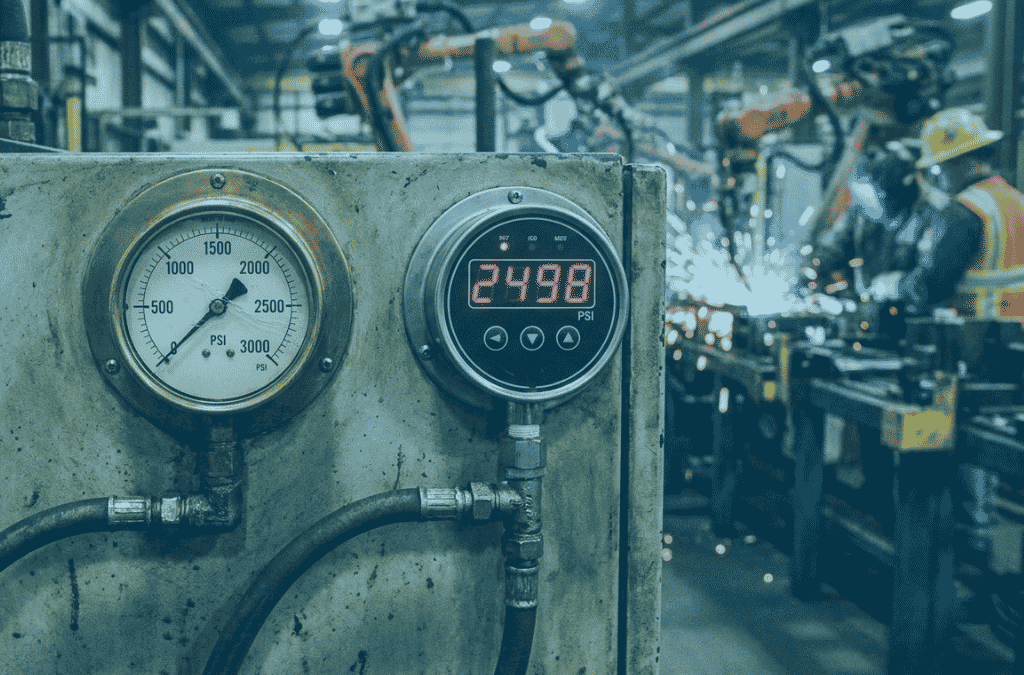
Choosing between digital and analog pressure gauges is an important decision for any industrial plant. Whether you operate in petrochemical processing, manufacturing, mining, steel, utilities, food production or general engineering, the right pressure gauge helps your team monitor systems accurately, protect equipment and maintain safe operating conditions.
For companies in Sasolburg, Vaalpark, Naledi Industrial Park and the wider Vaal Triangle, the decision is not only about the gauge itself. It is also about local supply, lead time, calibration support and choosing a pressure gauge supplier that understands industrial working environments.
Blanes Pressure Solutions supplies industrial pressure measurement instruments for demanding plant conditions, helping maintenance teams, engineers and procurement departments choose gauge solutions suited to their process, pressure range and accuracy requirements.
What Is an Analog Pressure Gauge?
An analog pressure gauge is a mechanical instrument that displays pressure using a dial and pointer. It is one of the most widely used pressure measurement tools in industrial environments because it is simple, reliable and easy to read at a glance.
Analog gauges are commonly used on pumps, compressors, tanks, pipelines, boilers, hydraulic systems, pneumatic lines and process equipment. In many plants, analog gauges remain the preferred option because they do not require batteries, are cost-effective and are available in a wide range of sizes, materials and pressure ranges.
For harsh industrial conditions, analog gauges can also be selected with features such as stainless steel cases, glycerine filling, vibration resistance, over-pressure protection, chemical seals, snubbers and other accessories that help extend service life.
What Is a Digital Pressure Gauge?
A digital pressure gauge uses an electronic sensor to measure pressure and display the reading on a digital screen. These gauges are often chosen where higher readability, improved accuracy, data logging or precise test readings are required.
Digital pressure gauges are commonly used for calibration checks, quality control, test benches, maintenance inspections and applications where small pressure changes must be monitored more clearly.
Unlike analog gauges, digital pressure gauges may require batteries or power supply, and they may need more careful handling depending on the working environment. However, they offer strong advantages where precision and clear numerical readings are important.
Digital vs Analog Pressure Gauges: Main Differences
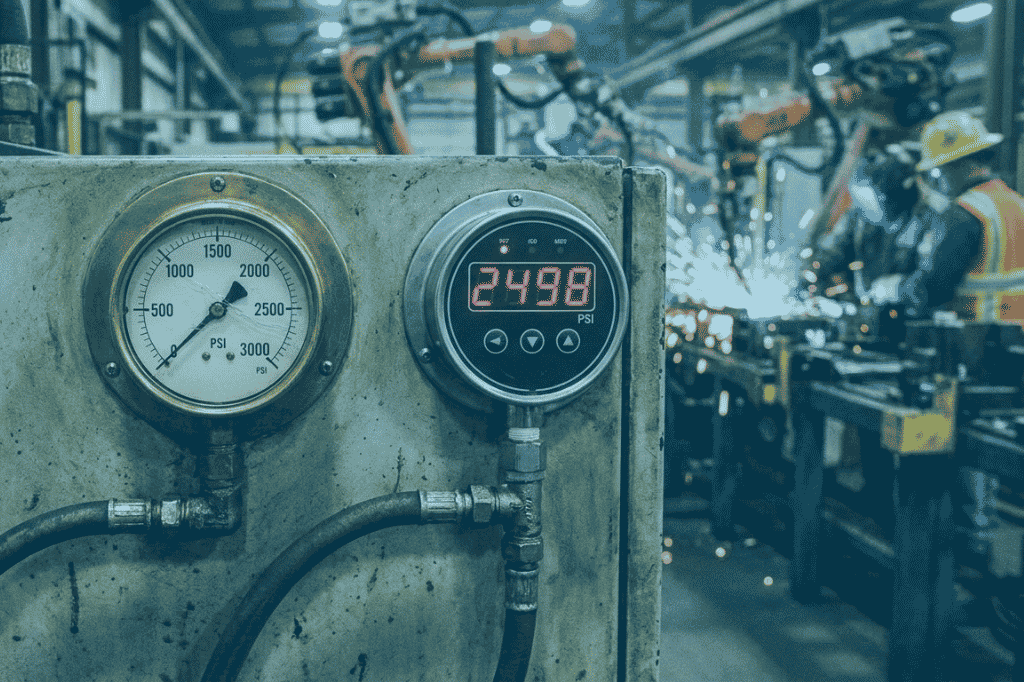
The best gauge depends on the application. Analog gauges are usually preferred for everyday plant monitoring, while digital gauges are often preferred for testing, calibration and high-accuracy measurement.
1. Accuracy
Digital pressure gauges generally offer higher reading precision because they display exact numerical values. This makes them useful for calibration work, inspection tasks and process checks where small changes matter.
Analog gauges can also be accurate when correctly selected and calibrated, but the reading depends on the dial scale and the operator’s interpretation of the pointer position.
2. Readability
Analog gauges are easy to scan quickly from a distance, especially when operators are checking multiple gauges during inspections. The pointer position gives a fast visual indication of whether pressure is within the normal operating range.
Digital gauges provide clear numerical readings, which helps reduce reading errors. They are useful when exact pressure values must be recorded.
3. Durability
Analog gauges are often robust and well-suited to general industrial use. When fitted with the correct case material, process connection, liquid filling and protection accessories, they can perform well in harsh environments.
Digital gauges can also be durable, but the electronic components must be matched carefully to the environment. Heat, moisture, vibration, impact and hazardous areas must all be considered before choosing a digital option.
4. Maintenance
Analog gauges are simple to maintain, but they must be checked for damage, zero error, pointer movement, vibration damage and calibration drift.
Digital gauges require battery checks, electronic inspection and calibration verification. They may offer improved accuracy, but they still need routine calibration to remain reliable.
5. Cost
Analog pressure gauges are usually more cost-effective for large-scale plant installations where many pressure points need to be monitored.
Digital pressure gauges often cost more, but they can add value where accuracy, testing, recording or maintenance verification is required.
When Should You Choose an Analog Pressure Gauge?
Analog pressure gauges are a practical choice for most everyday industrial pressure measurement applications. They are ideal when the operator needs a simple, visible and reliable reading at the point of use.
- The gauge is used for routine plant monitoring
- The reading needs to be visible at a glance
- The application does not require electronic output
- Cost-effective installation is important
- The environment is rugged or exposed to vibration
- The gauge must operate without batteries or power
- Multiple gauges are required across a plant
For plants in Sasolburg and the Vaal Triangle, analog gauges are often used in petrochemical facilities, fabrication workshops, manufacturing plants, pump systems, compressor rooms, water treatment systems and process lines.
When Should You Choose a Digital Pressure Gauge?
Digital pressure gauges are better suited to applications where accuracy, testing or exact reading values are important.
Choose a digital gauge when:
- Precise readings are required
- The gauge is used for calibration or inspection
- Operators need to record exact pressure values
- Small pressure changes must be monitored
- The application needs high accuracy
- Readability in low-light conditions is important
- The gauge forms part of a maintenance or testing process
Digital gauges are especially useful for maintenance teams, quality departments and instrumentation technicians who need reliable pressure data during inspections or equipment checks.
Which Gauge Is Better for Industrial Plants?
There is no single answer. In many industrial plants, the best solution is a combination of both.
Analog gauges are often used for permanent process monitoring, while digital pressure gauges are used for testing, calibration checks and maintenance verification.
For example, a plant may use analog gauges on pumps, vessels and pipelines, while the maintenance team uses digital gauges or test equipment to verify readings during inspections. This gives the plant a practical balance between durability, cost control and accuracy.
The most important step is to match the gauge to the application. Pressure range, media, temperature, vibration, connection type, accuracy requirement and calibration interval should all be considered before placing an order.
Do Digital and Analog Pressure Gauges Need Calibration?
Yes. Both digital and analog pressure gauges need calibration.
Analog gauges can drift due to vibration, mechanical wear, over-pressure, corrosion or repeated use. Digital gauges can also drift over time due to sensor performance, environmental exposure or electronic changes.
Calibration is important because it confirms whether the gauge is still reading correctly. In industrial environments, inaccurate pressure readings can lead to poor process control, equipment strain, safety risks and incorrect maintenance decisions.
A regular calibration schedule should be based on the application, risk level, operating conditions and internal quality requirements.
Supplier Support: What Should Industrial Buyers Ask?
When comparing digital vs analog pressure gauges, procurement teams should not only compare price. They should ask the supplier practical questions that affect long-term performance.
Ask your pressure gauge supplier:
- Is the gauge suitable for the pressure range and process media?
- Is the gauge available with the correct connection and case material?
- Can accessories such as chemical seals, snubbers or manifolds be supplied?
- What is the expected lead time?
- Can the gauge be supplied with calibration support?
- Is SANAS-traceable calibration available?
- Can the supplier recommend the correct gauge for the application?
These questions help reduce the risk of buying the wrong gauge for the job.
Digital vs Analog Pressure Gauges
For most industrial plants, analog pressure gauges remain a reliable and cost-effective choice for everyday process monitoring. Digital pressure gauges are best used where precise readings, calibration checks and high-accuracy measurement are required.
The right choice depends on your process, your working environment and your accuracy requirements.
For industrial companies in Sasolburg, Vaalpark, Naledi Industrial Park and the wider Vaal Triangle, Blanes Pressure Solutions can assist with pressure gauge supply, product selection and SANAS-traceable calibration support for both everyday plant use and more specialised measurement requirements.
FAQs
Which is better for industrial use: digital or analog pressure gauges?
Analog pressure gauges are often better for everyday plant monitoring because they are simple, durable and cost-effective. Digital pressure gauges are better for applications that require precise readings, testing or calibration checks. Many industrial sites use both depending on the application.
Where can I find a pressure gauge supplier in Sasolburg or the Vaal Triangle?
Blanes Pressure Solutions supplies industrial pressure gauges and pressure measurement instruments from the Sasolburg area, serving Vaalpark, Naledi Industrial Park and the wider Vaal Triangle. Local supply helps industrial customers with product selection, replacement planning and calibration support.
How long does it take to supply an industrial pressure gauge?
Lead time depends on the gauge type, pressure range, material, connection size, accessories and stock availability. Standard analog gauges may be quicker to source, while specialised digital gauges, stainless steel gauges or gauges with chemical seals may require additional lead time.
Do pressure gauges need SANAS-traceable calibration?
Pressure gauges should be calibrated when accuracy, safety, compliance or audit readiness is important. SANAS-traceable calibration gives industrial users confidence that the gauge has been checked against recognised measurement standards and can support quality or safety documentation.
What pressure gauge is best for harsh industrial environments?
For harsh industrial environments, choose a gauge based on pressure range, media compatibility, vibration, temperature and exposure conditions. Stainless steel gauges, vibration-resistant gauges, liquid-filled gauges, snubbers, chemical seals and over-pressure protection can help improve performance and service life.
We also offer SANAS traceable calibrations complete with a certificate, valid for 1 year on our premises.
Blanes Pressure Solutions supplies a comprehensive range of pressure measurement instruments.
Blanes Pressure Solutions was founded in 2002 to take over the pressure business of Blanes Instruments CC, and can trace its pedigree back to 1893, when Robert Blane left Scotland to make his fortune on the Witwatersrand.
For more information on placing orders, after care and maintenance services you can contact our Sales Manager Ronel Olivier on ronel@pressuresolutions.co.za or 011 422 1749.


