
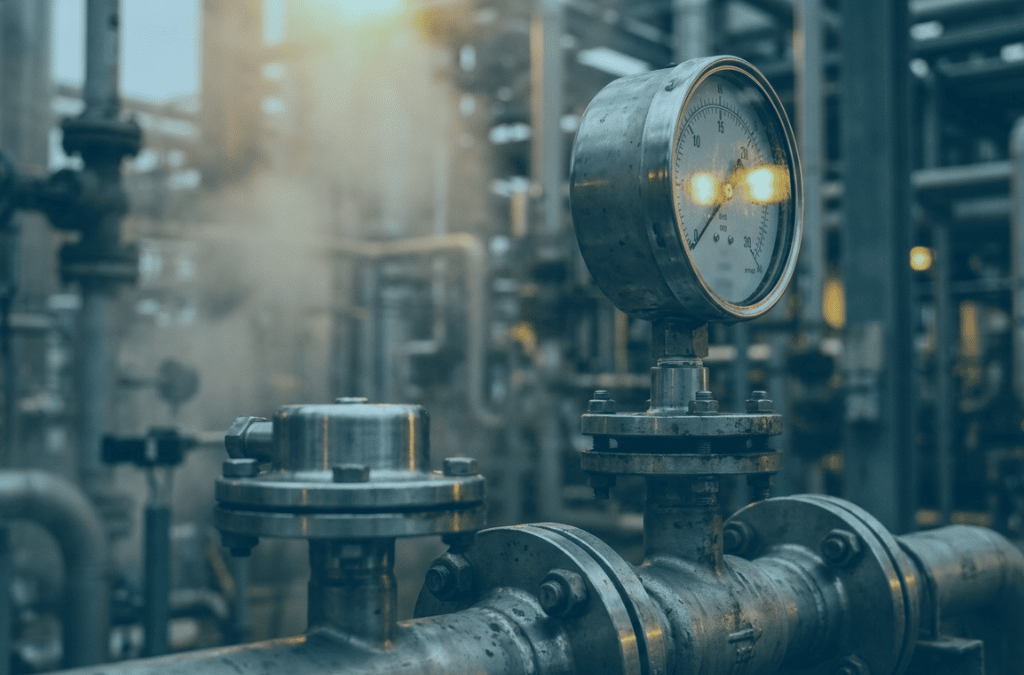
Quick Answer: How do you select a pressure gauge for a hazardous environment?
Selecting the right pressure gauge for a hazardous environment requires evaluating process media compatibility, operating temperatures, and potential pressure spikes. Engineers must utilize chemical diaphragm seals for corrosive fluids, liquid-filled cases for high vibration, and safety-pattern cases (with solid baffle walls and blow-out backs) to protect operators. Proper SANAS-traceable calibration and adherence to hazardous-area safety classifications are also critical.
Selecting the Right Pressure Gauge for Hazardous Environments
Pressure measurement becomes incredibly demanding when an instrument is installed around corrosive chemicals, flammable gases, aggressive media, or extreme temperatures.
In these hazardous applications, choosing a gauge simply because the thread fits and the numbers match your operating pressure is a recipe for catastrophic failure. You must consider the complete measurement point: what touches the process, the surrounding environment, potential failure modes, and required safety accessories.
For South African plants in the petrochemical, mining, and power generation sectors, Blanes Pressure Solutions helps engineers specify instrumentation based on actual process conditions, ensuring safety and longevity.
1. Start With Process Media Compatibility
The first critical question is: What exactly is touching the inside of this gauge?
The wetted parts of your instrument must be chemically compatible with the process fluid or gas. While stainless steel is the industrial standard, it is not immune to everything. Highly aggressive acids, solvents, or concentrated chemicals may require specialized alloys to prevent the internal sensing element from corroding and rupturing.
2. Isolate the Gauge with a Chemical (Diaphragm) Seal
Sometimes, the best way to protect a gauge is to physically prevent the process medium from ever reaching it. A chemical seal (or diaphragm seal) creates a physical barrier while still transmitting pressure readings to the gauge dial.
You should specify a chemical seal when the process medium is:
- Highly corrosive or toxic.
- Viscous, sludgy, or contaminated.
- Prone to crystallizing or clogging small pressure ports.
Crucial Distinction: A chemical seal isolates the gauge from the process fluid. Liquid-filling a gauge case protects it from mechanical vibration. They solve entirely different problems.
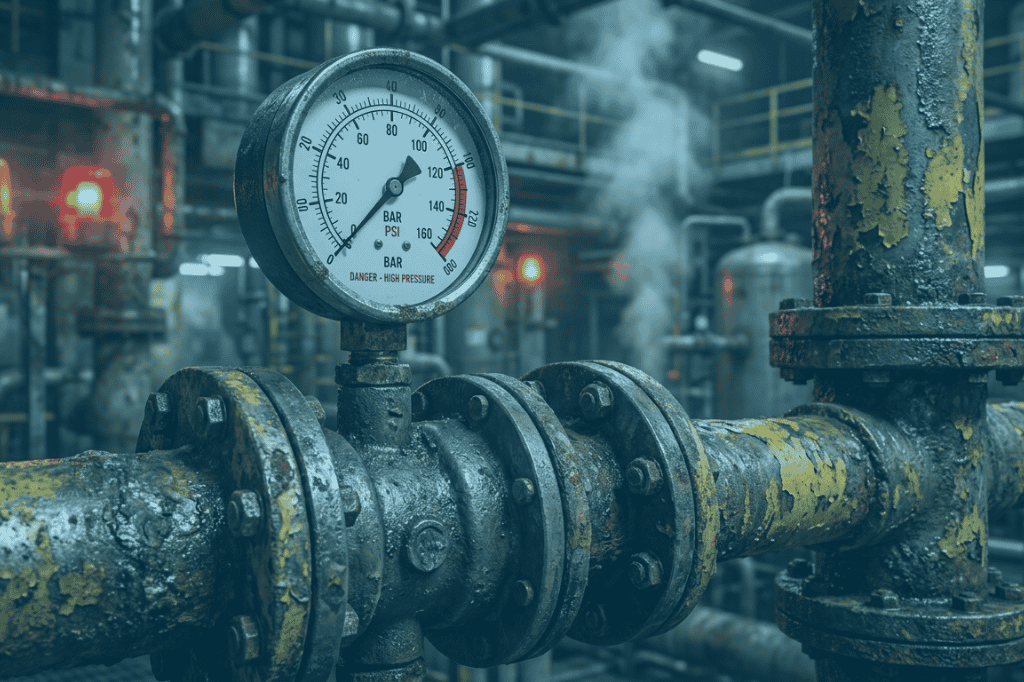
An industrial pressure gauge equipped with a heavy-duty chemical diaphragm seal to protect internal components from corrosive hazardous media.
3. Evaluate Gauge Safety Design
In hazardous areas, you must plan for worst-case scenarios. If a pressure element ruptures due to a chemical attack or massive overpressure, where does the blast go?
Safety-pattern gauges (such as EN 837 S3 designs) feature a solid metal baffle wall between the measuring system and the dial, combined with a blow-out back. If the internal tube bursts, the pressure and process fluid are safely vented out the back of the gauge, away from the operator’s face.
Furthermore, if your gauge includes electrical contacts or transmitters, it must strictly comply with your plant’s specific hazardous-area (Ex) classifications.
4. Select the Correct Pressure Range
A gauge constantly operating at the very edge of its maximum scale has zero capacity to absorb pressure surges. Conversely, a dial range that is far too high makes normal readings impossible to see accurately.
Always select a scale where your normal operating pressure sits squarely in the middle (around the 12 o’clock position). If your system is prone to severe, unpredictable spikes, install an over-range protector to physically block pressure surges from destroying the instrument.
5. Account for Vibration and Pulsation
Hazardous applications rarely present just one challenge. If heavy vibration or pulsation is present, you need specific accessories:
- Mechanical Vibration: Affects the outside of the gauge. Solution: Use a liquid-filled or vibration-resistant gauge to dampen the shaking.
- Pressure Pulsation: Violent fluid surges inside the pipe. Solution: Install a pressure snubber to choke the flow before it hits the gauge.
6. Temperature and Installation Constraints
Extreme temperatures can destroy gauge accuracy and degrade chemical seals. If the process is incredibly hot, mounting the gauge directly to the pipe will cook the instrument.
In these cases, utilize a diaphragm seal connected via a cooling capillary line. This allows you to mount the gauge safely on a nearby wall, dissipating the heat before it reaches the delicate internal mechanisms.
7. Verify Certification and Calibration
A gauge in a safety-critical hazardous environment must provide data you can trust with your life. Regular calibration against a traceable reference standard verifies that the instrument hasn’t drifted out of tolerance due to harsh conditions.
Blanes Pressure Solutions provides SANAS-traceable gauge calibration services, ensuring full regulatory compliance and documented measurement traceability for your facility.
A Better Way to Specify Hazardous-Area Gauges
Stop asking: “What pressure gauge do I need?”
Start asking: “What is the process medium? Is it hot? Does it pulsate? Will it clog? What happens if it fails?”
For engineers and procurement teams in Sasolburg, the Vaal Triangle, and across South Africa, Blanes Pressure Solutions provides expertly specified instruments, locally designed chemical seals, and the technical support needed to ensure your plant operates safely and efficiently.
Frequently Asked Questions
Tap on a question below to reveal the answer.
1. What pressure gauge is best for a hazardous environment?
There is no single “best” gauge. Selection must be based on process media compatibility, operating pressure, temperature extremes, vibration levels, and required safety features like blow-out backs or explosion-proof housings.
2. Is a stainless-steel gauge automatically safe for corrosive chemicals?
No. While stainless steel is highly resistant to many industrial fluids, specific acids, high concentrations, or extreme temperatures may easily corrode it. A specialized chemical seal or exotic alloy may be required.
3. When should I use a chemical (diaphragm) seal?
You should use a chemical seal whenever the process fluid is highly corrosive, toxic, sludgy, or prone to crystallizing. It acts as a physical barrier, preventing the fluid from entering and destroying the gauge’s delicate internals.
4. Are liquid-filled gauges better for hazardous areas?
Liquid-filled gauges are excellent for environments with heavy mechanical vibration. However, the liquid filling does nothing to protect the internal wetted parts from chemical corrosion—you still need to verify media compatibility.
5. How often should gauges in hazardous areas be calibrated?
Calibration intervals depend on the application’s risk level, historical drift data, and plant safety protocols. Critical applications typically require frequent SANAS-traceable calibration to ensure absolute accuracy and safety.
Helpful Internal Resources:
We also offer SANAS traceable calibrations complete with a certificate, valid for 1 year on our premises.
Blanes Pressure Solutions supplies a comprehensive range of pressure measurement instruments.
Blanes Pressure Solutions was founded in 2002 to take over the pressure business of Blanes Instruments CC, and can trace its pedigree back to 1893, when Robert Blane left Scotland to make his fortune on the Witwatersrand.
For more information on placing orders, after care and maintenance services you can contact our Sales Manager Ronel Olivier on ronel@pressuresolutions.co.za or 011 422 1749.


