

Industrial Gauges: How Accurate Measurement Protects Your Plant, People and Profit
In every plant, workshop or processing facility, there is one type of instrument you simply cannot do without: gauges.
From monitoring boiler pressure and product temperatures to checking fuel levels and flow rates, gauges give you the real-time data you need to keep operations safe, efficient and compliant.
In this blog, we unpack the main purposes and functions of industrial gauges, explore where they’re used, and show how Blanes Pressure Solutions supports South African industries with reliable instruments and SANAS-traceable calibration services.
What Is an Industrial Gauge?
An industrial gauge is a measuring instrument designed to display a physical variable in a way that’s easy for operators to read and act on. Common measured variables include:
-
Pressure – gases and liquids in pipes, vessels, cylinders and process lines
-
Temperature – of products, equipment, boilers and environments
-
Flow – volume or mass of liquid or gas moving through a line
-
Level – how full a tank, vessel or silo is
-
Speed and load – for rotating equipment or mechanical systems
Whether it’s an analogue dial or a digital display, the purpose is the same: turn invisible process conditions into clear, actionable information.
Core Functions of Pressure and Temperature Gauges
1. Accurate Measurement of Critical Parameters
At the most basic level, gauges provide accurate measurement of key process conditions:
-
Pressure gauges confirm that pumps, compressors, steam lines and hydraulic systems are operating within their design limits.
-
Temperature gauges track heating and cooling performance, protect sensitive equipment and help maintain product quality.
-
Differential pressure gauges monitor pressure drop across filters or orifice plates, indicating blockages or changes in flow.
Without trustworthy measurements, it’s impossible to make good decisions about production, maintenance or safety.
2. Real-Time Monitoring for Operators and Control Rooms
Gauges act as the eyes of the plant. By providing continuous readings, they allow operators to:
-
Spot abnormal trends early (rising pressure, falling level, unusual temperatures)
-
Adjust valves, setpoints or speeds before problems escalate
-
Verify that automated control systems are doing what they should
In many facilities, local gauges are positioned at key points on equipment, while transmitters send signals back to control systems for recording and alarms. Together, they create a complete monitoring picture.
3. Keeping People and Equipment Safe
One of the most important purposes of gauges is safety.
-
A pressure gauge on a steam line or receiver can warn of dangerous over-pressure conditions long before a relief valve lifts.
-
Gauges on gas cylinders, fire extinguishers and air receivers confirm that equipment is charged, safe and ready for use.
-
Temperature gauges on critical assets help prevent overheating, thermal shock and premature failure.
By showing when conditions are drifting towards unsafe limits, gauges give teams time to take action – reducing the risk of accidents, unplanned shutdowns and costly damage.
4. Supporting Product Quality and Process Consistency
In manufacturing and processing environments, consistent quality depends on keeping process parameters within tight limits. Gauges support this by:
-
Verifying that pressure and temperature profiles match the process recipe
-
Highlighting deviations that could affect product quality (e.g. under-pressure in a filler line or incorrect curing temperature)
-
Helping maintenance teams identify issues such as blocked filters, failing pumps or leaking valves
When gauges are accurate and well-placed, they become one of your strongest tools for quality control and continuous improvement.
5. Enabling Preventative Maintenance and Reduced Downtime
Gauges also play a key role in condition-based and preventative maintenance. Abnormal readings often indicate that something is starting to go wrong:
-
An increasing differential pressure reading across a filter can signal that it’s time for cleaning or replacement.
-
A gradual change in system pressure may point to leaks, worn components or calibration drift.
-
Unusual temperature profiles might reveal fouling, poor insulation or failing heat-transfer equipment.
Acting on these early warning signs helps prevent breakdowns, reduces unplanned downtime and extends asset life.
6. Data Logging, Compliance and Traceability
Modern gauge and transmitter solutions often include data logging and digital communication. This allows you to:
-
Record measurements over time for audits and performance analysis
-
Prove compliance with industry regulations and quality standards
-
Support root-cause investigations after incidents or process upsets
When combined with SANAS-traceable calibration, historical data becomes a powerful tool for demonstrating that your instruments – and your processes – are under control.
Where Are Gauges Used? Key Industries and Applications
Gauges are found across almost every industrial sector. Typical examples include:
-
Mining and minerals processing – monitoring slurry lines, compressed air, hydraulic systems, water supply and dewatering
-
Chemical and petrochemical plants – controlling pressure and temperature in reactors, storage tanks, pipelines and utilities
-
Power generation and boilers – tracking steam pressure, feedwater conditions and cooling systems
-
Food and beverage – verifying process temperatures, CIP system pressures and packaging line performance
-
Pulp and paper – monitoring steam, boiler feedwater and paper machine hydraulics
-
General manufacturing and OEMs – ensuring safe operation of compressors, pumps, presses and specialised machinery
Wherever there is pressure, temperature, flow or level to be controlled, you’ll find gauges doing quiet, critical work in the background.
The Hidden Hero: Calibration of Gauges
Even the best gauge will drift over time due to mechanical wear, vibration, temperature cycling and normal ageing. That’s why regular calibration is non-negotiable.
Accurate calibration:
-
Confirms that the gauge still meets its specified tolerance
-
Ensures readings can be trusted for safety and compliance
-
Reduces the risk of costly mis-readings and wrong decisions
Blanes Pressure Solutions offers SANAS-traceable calibrations for gauges and testers, complete with a certificate valid for one year on their premises, with calibration equipment regularly certified by SANAS-accredited laboratories.
Why Choose Blanes Pressure Solutions for Your Gauges?
Blanes Pressure Solutions has a decades-long pedigree in pressure measurement and calibration, with roots that trace back to the late 1800s.
When you partner with Blanes, you benefit from:
-
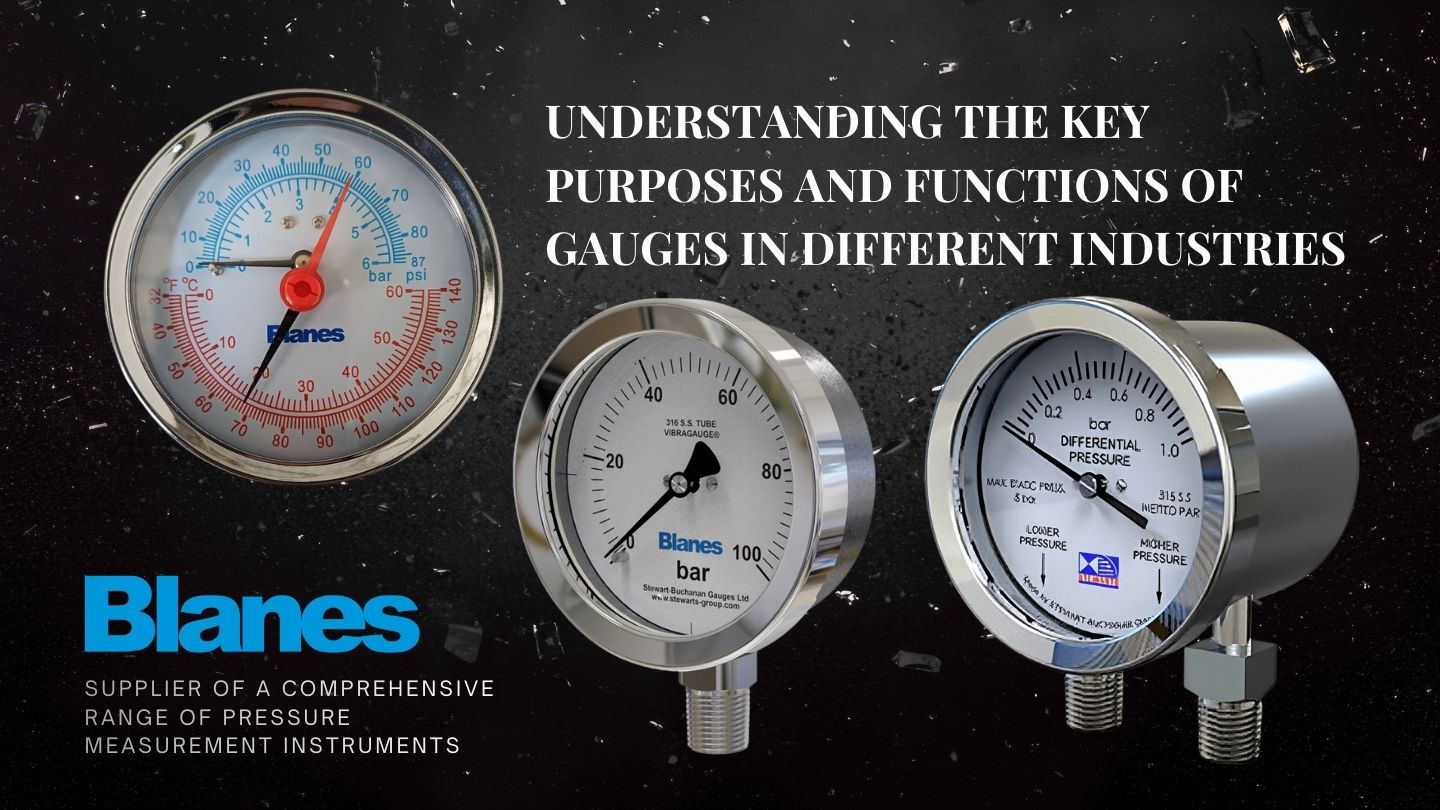
A comprehensive range of pressure measurement instruments, including general-purpose gauges, differential gauges, vibration-resistant gauges, thermo gauges and chemical seals
-
Access to leading global brands in gauges, switches, transmitters, valves and manifolds
-
Local expertise in specifying the right instrument for South African conditions and industries
-
In-house assembly and custom builds, including special dial ranges, connections and materials
-
SANAS-traceable calibration and after-sales support to keep your instruments accurate throughout their lifecycle
Whether you’re an OEM, plant engineer or maintenance manager, Blanes can help you design a measurement solution that fits your process and your budget.
How to Choose the Right Gauge for Your Application
When selecting a gauge, consider:
1. Measured Medium
Gas, liquid, slurry or steam?
Any risk of crystallisation, clogging or corrosion?
2. Pressure or Temperature Range
Operating range and maximum possible pressure/temperature
Safety margins and over-pressure protection
3. Accuracy Requirements
Do you need a high-precision test gauge or a robust process gauge?
What is the required accuracy class?
4. Process Connection and Mounting
Thread size, orientation, panel mounting, remote mounting, etc.
5. Environment
Vibration, ambient temperature, weather exposure or wash-down conditions
The Blanes team can assist you in matching the right gauge type, range and construction to your exact process conditions.
Frequently Asked Questions About Industrial Gauges
Q1: How often should industrial gauges be calibrated?
A: Calibration intervals depend on your process risk, regulatory requirements and operating conditions. Many industrial plants calibrate critical gauges annually or more often for high-risk applications. Blanes can help you define a calibration schedule that suits your plant.
Q2: What are the signs that a gauge may be inaccurate?
A: Common warning signs include sluggish response, pointers not returning to zero, inconsistent readings compared to other instruments, or visible damage to the case or window. Any of these should trigger a check and possible recalibration.
Q3: Are digital gauges better than analogue gauges?
A: Both have their place. Analogue gauges are robust, easy to read at a glance and require no power. Digital gauges offer higher resolution, data logging and communication options. The best choice depends on how the gauge will be used.
Q4: Can gauges be customised for special applications?
A: Yes. Blanes can provide gauges with special ranges, dial designs, case materials, process connections and chemical seals to suit aggressive media, high vibration or high-temperature installations.
Partner with Blanes Pressure Solutions for Reliable Gauges and Calibration
Industrial gauges may look simple, but the data they provide is critical to the safety, efficiency and profitability of your operations. When you combine quality instruments with professional, SANAS-traceable calibration, you gain the confidence that every reading can be trusted.
For help with:
-
Selecting the correct pressure, temperature, differential or test gauge
-
Upgrading existing measurement points
-
Setting up a calibration and maintenance programme
Contact Blanes Pressure Solutions today:
-
Sales: Ronel Olivier
-
Tel: +27 11 422 1749
Let’s make sure your gauges are doing what they should – protecting your plant, people and profits.
We also offer SANAS traceable calibrations complete with a certificate, valid for 1 year on our premises.
Blanes Pressure Solutions supplies a comprehensive range of pressure measurement instruments.
Blanes Pressure Solutions was founded in 2002 to take over the pressure business of Blanes Instruments CC, and can trace its pedigree back to 1893, when Robert Blane left Scotland to make his fortune on the Witwatersrand.
For more information on placing orders, after care and maintenance services you can contact our Sales Manager Ronel Olivier on ronel@pressuresolutions.co.za or 011 422 1749.


