

Choosing the right industrial gauge for your plant is about far more than finding a unit that fits a pipe connection. The correct gauge helps protect equipment, improve process accuracy, support plant safety, and reduce unnecessary downtime. The wrong choice can lead to unreliable readings, faster wear, poor performance, and avoidable maintenance issues. That is why gauge selection should always be linked to your actual operating conditions, process demands, and long-term plant goals. Blanes Pressure Solutions supplies a wide range of industrial gauges in South Africa, including pressure gauges, thermo gauges, differential gauges, test gauges, vibration-resistant gauges, and related instrumentation for demanding applications.
In many plants, gauges are treated as simple accessories. In reality, they are critical measuring instruments. A good gauge gives operators confidence in what is happening inside the process. It supports better control, quicker fault finding, and more stable production conditions. Whether your plant operates in mining, manufacturing, chemical processing, water treatment, power generation, or general industry, choosing the right industrial gauge is an important technical decision.
Why Gauge Selection Matters
An industrial gauge must do more than display a reading. It needs to withstand the environment, suit the media, match the operating range, and remain readable and reliable over time. Blanes’ own guidance highlights that the right gauge selection affects safer operations, accurate readings, longer equipment life, and lower lifecycle cost. When a gauge is correctly matched to the application, the plant benefits from improved uptime and fewer instrumentation-related problems.
If the gauge is not suited to the application, problems can develop quickly. Corrosive media may damage wetted parts. Vibration can shorten instrument life. Incorrect range selection can reduce readability or overload the unit. Poor compatibility with the process may also affect accuracy and maintenance frequency. This is why plants should never choose gauges on price alone.
1. Identify What You Need to Measure
The first step is to understand exactly what the gauge must measure. Some applications require pressure measurement, while others require temperature measurement or even a combination of both. Blanes Pressure Solutions offers several relevant categories, including general pressure gauges, thermo gauges, differential gauges, and combination pressure-temperature gauges.
Ask the following:
- Are you measuring pressure, temperature, or both?
- Is the process media gas, liquid, steam, slurry, or a corrosive chemical?
- Is the reading for general monitoring, safety verification, or precise testing?
- Will the gauge be used continuously or only during inspections and maintenance?
Answering these questions early helps narrow the correct gauge type and improves the chance of choosing an instrument that performs well in the field. This approach aligns with Blanes’ published selection guidance, which begins with the measured medium and the process conditions.
2. Match the Gauge to the Process Media
Not every industrial gauge is suitable for every process. The media inside the system plays a major role in gauge selection. Clean air or water may require a different solution from steam, viscous liquids, abrasive materials, or corrosive chemicals. Blanes specifically notes that harsh media can require protective solutions such as chemical seals, also known as diaphragm seals, to protect instruments from corrosive, contaminated, or high-viscosity process fluids.
If the process media can clog, crystallise, corrode, or attack internal components, a standard gauge may not last. In these cases, the correct material selection and accessory choice are just as important as the gauge itself. For harsh applications, it is often better to choose a more robust configuration from the start than to replace failed gauges repeatedly.
3. Choose the Correct Pressure or Temperature Range
Range selection is one of the most important parts of choosing an industrial gauge. A gauge should be selected so that normal operating conditions fall comfortably within its working range. If the range is too narrow, the instrument may be exposed to overload conditions. If the range is too wide, the reading may become less precise and harder to interpret. Blanes’ selection advice specifically highlights the importance of operating range, maximum possible pressure or temperature, and safety margins.
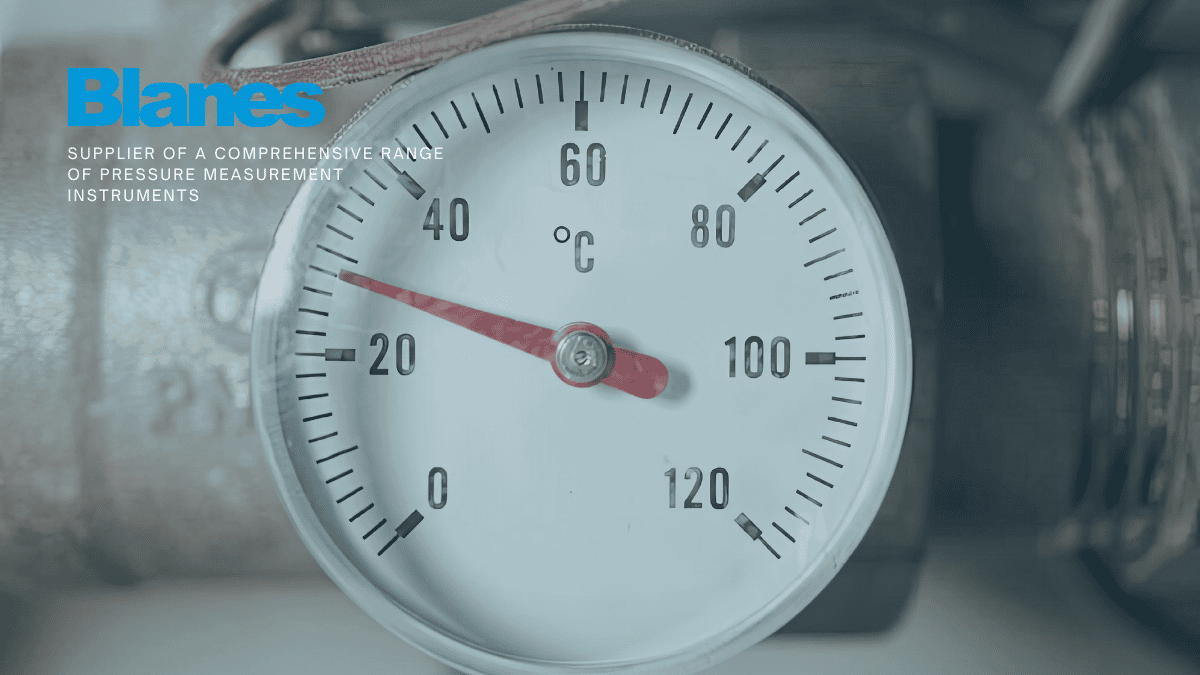
For temperature applications, Blanes’ thermo gauge offering includes options such as rigid stem bi-metal stainless steel thermometers, distant reading thermometers, inert gas thermometers, and any-angle models, showing that different measuring ranges and mounting needs require different solutions.
4. Consider Accuracy Requirements
Different plant duties require different levels of accuracy. A gauge used for general indication may not need the same precision as a test gauge used in calibration, verification, or troubleshooting. Blanes’ product structure includes test gauges alongside general gauges, which reflects the importance of matching the instrument to the level of accuracy required by the task.
Before choosing a gauge, ask:
- How critical is the reading to the process?
- Is this for routine observation or a high-accuracy application?
- Will the reading be used for compliance, maintenance, or calibration checks?
The more critical the reading, the more important it becomes to select the correct accuracy class and maintain calibration over time. Blanes also promotes SANAS-traceable calibration support, which strengthens reliability for plants that need confidence in measurement accuracy.
5. Look at the Environment Around the Gauge
Industrial plants are rarely gentle on instrumentation. Vibration, pulsation, outdoor exposure, temperature variation, dirt, shock, and moisture can all reduce gauge performance if the instrument is not built for the job. Blanes supplies a dedicated vibration-resistant gauge designed for vibration and pulsating process signals, with a movement intended to keep the pointer steady and improve reliability.
This is a good reminder that the environment matters just as much as the process line itself. If the gauge will be installed near pumps, compressors, or rotating equipment, vibration resistance may be essential. If the instrument will face weather or washdown conditions, the casing and material specification should reflect that. If readability from different positions is important, an all-angle thermometer may be the better choice.
6. Check the Mounting and Connection Requirements
Gauge performance also depends on how and where it is installed. Rear connection, bottom connection, panel mounting, direct mounting, and remote or distant reading configurations can all affect suitability. Blanes’ available products include multiple mounting and connection styles across its thermo gauge and pressure gauge ranges.
Choosing the wrong mounting style can make the gauge difficult to read, awkward to service, or more vulnerable to failure. Good installation planning improves usability, protects the instrument, and helps keep readings visible to operators and maintenance teams.
7. Think About Safety and Application Risk
Some applications call for additional protection because the consequences of failure are higher. High pressure, hazardous media, oxygen service, high temperatures, or aggressive process conditions may require a specialised gauge design rather than a standard model. Blanes’ product range includes specific options such as safety pattern gauges, oxygen gauges, low-pressure draught gauges, and specialist pressure accessories, showing that application risk should shape the selection process.
A plant should always ask whether the measuring point has unusual risk factors. If it does, a more specialised solution is often the smarter long-term choice.
8. Plan for Maintenance, Calibration, and Longevity
Choosing the right industrial gauge also means thinking beyond installation day. Instruments need to remain reliable over time, and plants benefit from choosing gauges that can be supported with calibration, replacement, accessories, and technical advice. Blanes Pressure Solutions offers SANAS-traceable calibrations with certificates valid for one year on its premises, alongside product supply and application support.
This combined supply-and-support model is valuable because the best gauge is not only the one that works today, but the one that can be maintained properly over its service life.
Common Mistakes When Choosing an Industrial Gauge
Plants often run into avoidable problems because of a few common selection mistakes:
- Choosing a gauge with the wrong range
- Ignoring process media compatibility
- Using a standard gauge in a corrosive environment
- Overlooking vibration and pulsation
- Selecting the wrong mounting arrangement
- Failing to consider accuracy requirements
- Forgetting about calibration and lifecycle support
These issues are consistent with the selection risks Blanes already addresses across its site and related articles.
Why Work with a Specialist Supplier?
Choosing the right gauge becomes much easier when you work with a supplier that understands industrial applications rather than simply selling products off a shelf. Blanes Pressure Solutions positions itself around application-specific selection, technical support, calibration support, and a broad instrumentation range for South African industry. That matters because the right advice can prevent incorrect purchases, repeated replacements, and process measurement problems later on.
If your plant needs help selecting the best gauge for pressure, temperature, vibration-prone duties, corrosive environments, or specialist applications, it is worth speaking to a team that can match the instrument to the actual process conditions.
Choosing the right industrial gauge for your plant is a practical decision with real consequences for performance, safety, reliability, and maintenance cost. The correct gauge should match the media, measuring range, environmental conditions, accuracy needs, and installation setup of the application. When those factors are considered properly, your plant benefits from better readings, better control, and better long-term value. Blanes Pressure Solutions’ current range and published guidance strongly support this application-driven approach to gauge selection.
FAQs
1. How do I choose the right industrial gauge for my plant?
Start by identifying what you need to measure, the process media, the required range, the environmental conditions, and the level of accuracy needed. Blanes’ own guidance highlights these as core selection factors.
2. What is the difference between a pressure gauge and a thermo gauge?
A pressure gauge measures pressure in a system, while a thermo gauge measures temperature. Blanes offers both categories, along with combination pressure-temperature gauges for selected applications.
3. When should I use a vibration-resistant gauge?
A vibration-resistant gauge is useful where pumps, compressors, or pulsating process signals could cause unstable readings or premature wear. Blanes supplies a dedicated vibration-resistant model for these conditions.
4. Why do corrosive applications need special gauge selection?
Corrosive or contaminated media can damage standard instruments, so protective solutions such as chemical seals or specialised materials may be needed.
5. Does calibration matter when choosing a gauge?
Yes. Calibration support helps maintain accuracy over time, especially where readings are critical to quality, maintenance, or compliance. Blanes promotes SANAS-traceable calibration services for this reason.
We also offer SANAS traceable calibrations complete with a certificate, valid for 1 year on our premises.
Blanes Pressure Solutions supplies a comprehensive range of pressure measurement instruments.
Blanes Pressure Solutions was founded in 2002 to take over the pressure business of Blanes Instruments CC, and can trace its pedigree back to 1893, when Robert Blane left Scotland to make his fortune on the Witwatersrand.
For more information on placing orders, after care and maintenance services you can contact our Sales Manager Ronel Olivier on ronel@pressuresolutions.co.za or 011 422 1749.


